This function computes and visualizes scree curves for principal component
analysis, including the usual non-private curve and one or more
differentially private estimates. It is a plotting wrapper around
dp_scree() and returns a ggplot object.
Arguments
- X
A numeric matrix or data frame. Rows correspond to observations and columns correspond to variables.
- k
Positive integer defining the number of leading principal components to estimate. Must be an integer between
1and the number of columns inX.- method
Scree estimation method or methods to plot. One or more of
"clipped","pmwm", or"huber". If omitted,"clipped"is used.- control
Optional method-specific control list, or a named list of control lists when multiple methods are requested. Use
clipped_control(),pmwm_control(), andhuber_control().- eps
Positive number defining the total
epsilonprivacy parameter. Ifg_dppca = TRUE, it is split between private direction estimation and private scree estimation.- delta
Number in
(0, 1)defining the totaldeltaprivacy parameter. Ifg_dppca = TRUE, it is split between private direction estimation and private scree estimation.- center
A logical value indicating whether to center the columns of
Xbefore computing principal component directions. The default isTRUE.- standardize
A logical value indicating whether to scale the columns of
Xby their sample standard deviations after optional centering. The default isFALSE.- g_dppca
A logical value indicating whether to use private principal component directions for scree estimation. The default is
FALSE. Seedp_pc_dir()for details.- cpp.option
A logical value passed to
dp_pc_dir()wheng_dppca = TRUE. The default isFALSE. Wheng_dppca = TRUE,dp_pc_dir()is called with argumentseps = eps / 2anddelta = delta / 2.- mono
A logical value indicating whether to apply monotone post-processing to the private scree vector. The default is
TRUE.- type
Quantity to plot. Use
"pve"to plot proportions of variance explained and"scree"to plot raw scree values. The default is"pve".
Value
Invisibly returns a list with components:
nonprivate: non-private scree and PVE values.results: method-specificdp_scree()outputs used in the plot.
Details
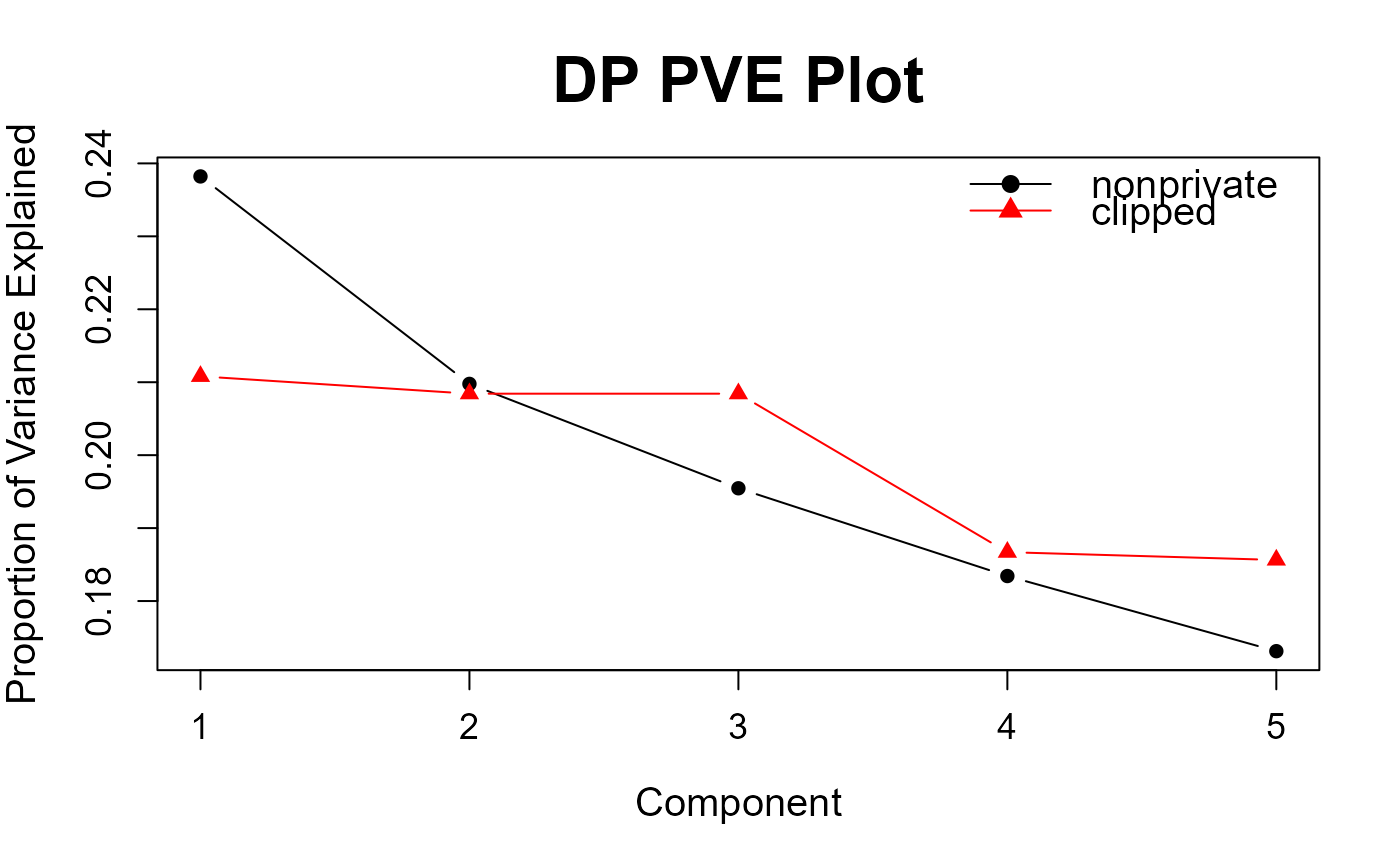
This function is a plotting wrapper around dp_scree(). For each requested
method, it computes a private scree estimate and overlays it with the
corresponding non-private curve. When type = "pve", the plotted quantity is
the proportion of variance explained (PVE); when type = "scree", the raw
scree values are shown.
To plot multiple methods, pass a character vector to method. If a method
requires tuning parameters, pass control as a named list, for example
control = list(clipped = clipped_control(), pmwm = pmwm_control(), huber = huber_control()).
For the estimating equations, privacy-budget allocation, and method-specific
construction, see dp_scree().
References
Dwork C, Roth A (2014). “The Algorithmic Foundations of Differential Privacy.” Found. Trends Theor. Comput. Sci., 9(3–4), 211–407. ISSN 1551-305X, doi:10.1561/0400000042 .
Ramsay K, Spicker D (2025). “Improved subsample-and-aggregate via the private modified winsorized mean.” Code available at https://github.com/12ramsake/PMWM, 2501.14095, https://arxiv.org/abs/2501.14095.
Yu M, Ren Z, Zhou W (2024). “Gaussian differentially private robust mean estimation and inference.” Bernoulli, 30(4), 3059–3088.
Kim M, Jung S (2025). “Robust and Differentially Private Principal Component Analysis.” Statistical Analysis and Data Mining: An ASA Data Science Journal, 18(6), e70053. doi:10.1002/sam.70053 .
See also
dp_pc_dir() for principal component direction estimation.
dp_scree() for computing non-private and differentially private scree
estimates.
clipped_control(), pmwm_control(), and huber_control() for
method-specific tuning parameters.
Examples
data(gau, package = "dppca")
# Use a small subset to keep the example fast.
X <- gau[1:200, ]
# Draw a private scree plot using the clipped mean method.
set.seed(123)
dp_scree_plot(
X,
k = 5,
method = "clipped",
control = clipped_control(C_clip = 3),
eps = 3,
delta = 1e-3
)
 # Multiple scree methods can be overlaid by passing a vector to `method`
# and a named list to `control`, for example:
# dp_scree_plot(
# X,
# k = 5,
# method = c("clipped", "pmwm", "huber"),
# control = list(
# clipped = clipped_control(C_clip = 3),
# pmwm = pmwm_control(a = 0, b = 50, trim_const = 10, eta = 0.01),
# huber = huber_control(k_min_m2 = -10, k_max_m2 = 10, m2_frac = 1 / 4)
# ),
# eps = 3,
# delta = 1e-3
# )
# Multiple scree methods can be overlaid by passing a vector to `method`
# and a named list to `control`, for example:
# dp_scree_plot(
# X,
# k = 5,
# method = c("clipped", "pmwm", "huber"),
# control = list(
# clipped = clipped_control(C_clip = 3),
# pmwm = pmwm_control(a = 0, b = 50, trim_const = 10, eta = 0.01),
# huber = huber_control(k_min_m2 = -10, k_max_m2 = 10, m2_frac = 1 / 4)
# ),
# eps = 3,
# delta = 1e-3
# )